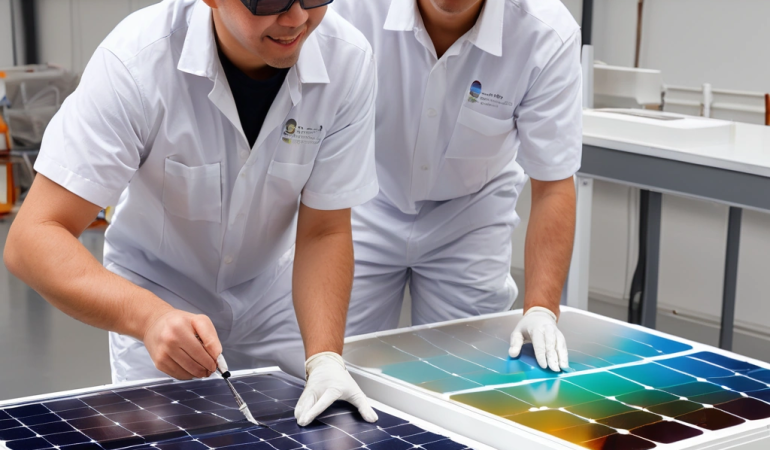
Painting the Future: Solar Paint’s Renewable Energy Revolution
Imagine a world where every surface – from the walls of your home to the roof of your car – generates electricity simply by being exposed to sunlight. This isn’t science fiction; it’s the tantalizing promise of solar paint, a revolutionary renewable energy technology poised to transform how we power our lives. While traditional solar panels have made significant strides, solar paint offers a more versatile and aesthetically integrated approach to harnessing the sun’s energy.
But can this paint truly deliver on its promise, and what hurdles stand in the way of its widespread adoption? Solar paint, also known as energy-generating paint or renewable energy coatings, represents a paradigm shift in how we think about solar energy. Instead of bulky, rigid panels, envision a future where thin-film solar cells are seamlessly integrated into the very fabric of our built environment. This vision aligns perfectly with the growing demand for building integrated photovoltaics (BIPV), where solar technology becomes an integral part of building design, enhancing both functionality and aesthetics.
The allure of solar paint lies in its potential to democratize renewable energy. Unlike traditional solar panel installations that require specialized mounting and significant structural considerations, solar paint can be applied to virtually any surface with minimal disruption. This opens up a world of possibilities, from retrofitting existing buildings to incorporating solar energy generation into the design of new infrastructure. Furthermore, the materials science behind solar paint is rapidly evolving, with advancements in perovskites and quantum dots leading to increased efficiency and stability.
These emerging technologies promise to overcome the limitations of earlier solar cell technologies, paving the way for cost-effective and scalable production of solar paint. The development of non-toxic and durable formulations is also a key area of focus, ensuring the long-term sustainability of this promising technology. However, the path to widespread adoption of solar paint is not without its challenges. Currently, the efficiency of solar paint lags behind that of traditional silicon-based solar panels, although rapid progress is being made.
Moreover, the long-term stability and durability of solar paint, particularly in harsh environmental conditions, need to be further validated. Issues such as moisture resistance, UV degradation, and thermal cycling are critical factors that can affect the lifespan and performance of solar paint. Overcoming these challenges requires continued innovation in materials science, advanced manufacturing techniques, and rigorous testing protocols. Despite these hurdles, the potential benefits of solar paint – including reduced reliance on fossil fuels, lower carbon emissions, and increased energy independence – make it a compelling area of research and development for a sustainable future.
The Science of Solar Paint: Perovskites, Quantum Dots, and the Photovoltaic Effect
The science underpinning solar paint resides in its intricate composition, primarily featuring semiconductor materials adept at capturing solar radiation and converting it into electricity via the photovoltaic effect. Perovskites and quantum dots stand out as the most promising materials driving this technological frontier. Perovskites, named in honor of Russian mineralogist L.A. Perovski, are calcium titanium oxide minerals that possess a distinctive crystal structure supremely suited for solar energy conversion. Their unique atomic arrangement facilitates efficient light absorption and charge carrier transport, rivaling traditional silicon-based solar cells in laboratory settings.
Quantum dots, conversely, are nanocrystals exhibiting quantum mechanical properties, enabling them to absorb varying wavelengths of light contingent upon their size. This size-tunable absorption is a significant advantage, allowing for spectral tuning to maximize sunlight capture across different environmental conditions. These renewable energy coatings represent a paradigm shift in building integrated photovoltaics, offering the potential to transform ordinary surfaces into energy-generating assets. When sunlight impinges upon solar paint, perovskites or quantum dots initiate the photovoltaic process by generating electron-hole pairs.
These pairs, also known as excitons, represent the fundamental units of electrical charge carriers within the material. Subsequently, these electron-hole pairs must be efficiently separated and collected to produce usable electric current. This separation is typically achieved through built-in electric fields within the material or at interfaces with other materials. The efficiency of this charge separation and collection process is paramount to the overall performance of the solar paint. Factors such as material purity, defect density, and the presence of grain boundaries can significantly impact charge transport and recombination rates.
Furthermore, the architecture of the solar paint, including the arrangement of the active materials and the incorporation of charge transport layers, plays a crucial role in optimizing performance. The interplay of these factors dictates the overall efficiency of these thin-film solar cells. Recent advancements in materials science have focused on enhancing the stability and efficiency of both perovskite solar cells and quantum dot solar paint. For perovskites, researchers are exploring novel compositions and additives to mitigate degradation caused by moisture and heat, two major challenges hindering their widespread adoption.
Encapsulation techniques and the development of more robust perovskite formulations are also being actively pursued. In the realm of quantum dots, efforts are directed towards improving their quantum yield, which is a measure of their efficiency in converting absorbed photons into electron-hole pairs. Surface passivation strategies and the incorporation of quantum dots into optimized matrix materials are key areas of investigation. Moreover, the development of lead-free quantum dots is gaining momentum due to environmental concerns associated with lead-containing materials. These advancements are crucial for realizing the full potential of solar paint as a clean energy technology.
From Lab to Reality: The Current Stage of Solar Paint Development
Solar paint technology is rapidly advancing through various stages of development, from initial laboratory experiments to real-world pilot projects. While commercially available solar paint, specifically energy-generating paint, remains limited, the promise of renewable energy coatings is driving intense research and development efforts across numerous companies and institutions. Researchers are meticulously experimenting with different material compositions and innovative manufacturing techniques to enhance the performance and stability of both perovskite solar cells and quantum dot solar paint.
These efforts are crucial to unlocking the full potential of solar energy through readily applicable coatings. The focus extends beyond mere efficiency; the goal is to create solar paint that seamlessly integrates into existing infrastructure, contributing to clean energy production and promoting sustainable energy practices. A significant hurdle in the progression of solar paint, particularly for perovskites, lies in its inherent instability. Perovskites are susceptible to degradation when exposed to moisture, ultraviolet (UV) light, and thermal stress, which drastically reduces their lifespan and overall performance.
To combat this, materials scientists are exploring various encapsulation techniques, including protective polymer coatings and specialized barrier layers, to shield the perovskites from environmental factors. Furthermore, compositional modifications, such as doping with specific elements and surface passivation strategies, are being investigated to enhance the intrinsic stability of perovskite materials. These advancements are critical for ensuring the long-term viability and reliability of perovskite-based solar paint in real-world applications. Quantum dots offer an alternative approach to solar paint, providing enhanced stability and reduced toxicity compared to some perovskite formulations.
Quantum dot solar paint leverages the unique quantum mechanical properties of these nanoscale semiconductors to absorb sunlight across a broad spectrum. Researchers are actively working on improving the efficiency of quantum dot-based solar cells through precise control over their size, shape, and composition. Surface ligands play a crucial role in passivating the quantum dot surface and facilitating efficient charge transport. Moreover, the development of novel quantum dot architectures, such as core-shell structures and graded alloy compositions, holds promise for further enhancing their performance. The ongoing refinement of quantum dot technology is paving the way for highly stable and efficient thin-film solar cells that can be readily integrated into energy-generating paint. The race is on to optimize both perovskite and quantum dot technologies for widespread use in building integrated photovoltaics and other applications, transforming surfaces into distributed renewable energy sources.
Applications Across Industries: Residential, Commercial, Automotive, and Aerospace
The versatility of solar paint unlocks a spectrum of applications across diverse industries, heralding a new era of distributed renewable energy generation. In the residential sector, envision homes transformed into self-sufficient energy hubs, with roofs, walls, and even windows coated in energy-generating paint, seamlessly blending aesthetics with functionality. Commercial buildings stand to gain significantly, reducing their carbon footprint and operational costs by harnessing solar energy directly from their facades. According to a recent report by the U.S.
Energy Information Administration, buildings account for approximately 40% of total energy consumption, highlighting the immense potential of building integrated photovoltaics like solar paint to drive down energy demand and promote sustainable energy practices. The ability to apply these renewable energy coatings to existing infrastructure offers a cost-effective pathway to decarbonization, making clean energy accessible to a wider range of consumers and businesses. The automotive industry presents another compelling application for solar paint. Integrating thin-film solar cells directly into car bodies can provide supplemental power for electric vehicles, extending their driving range and reducing reliance on external charging infrastructure.
Imagine a future where electric vehicles passively recharge while parked in the sun, minimizing range anxiety and maximizing energy efficiency. “Solar paint has the potential to revolutionize the automotive industry by turning vehicles into mobile power plants,” notes Dr. Emily Carter, a leading materials scientist at Princeton University. Beyond electric vehicles, solar paint could also power auxiliary systems in traditional combustion engine vehicles, reducing fuel consumption and emissions. This convergence of automotive engineering and materials science paves the way for more sustainable transportation solutions.
The aerospace sector stands to benefit immensely from the lightweight and flexible nature of solar paint. Applying these renewable energy coatings to satellites and spacecraft can provide a continuous source of power, extending their operational lifespan and reducing the need for frequent refueling missions. In remote sensing applications, where long-duration missions are critical, solar paint can ensure uninterrupted power supply for onboard sensors and communication systems. Furthermore, the reduced weight compared to traditional silicon-based solar panels translates to significant cost savings in launch expenses.
As space exploration intensifies, solar paint offers a compelling solution for powering future missions and enabling more sustainable space operations. The development of durable and efficient perovskite solar cells and quantum dot solar paint formulations is crucial for realizing the full potential of this technology in the demanding environment of space. Despite the exciting potential, it’s important to acknowledge the existing limitations. While solar paint offers ease of application and aesthetic flexibility, its current energy conversion efficiency lags behind traditional silicon-based solar panels.
Furthermore, concerns surrounding the long-term stability and environmental impact of certain materials, such as lead in some perovskite formulations, need to be addressed through ongoing research and development. However, the continuous advancements in materials science and nanotechnology are steadily improving the performance and sustainability of solar paint, paving the way for its widespread adoption across various sectors. The future of renewable energy coatings hinges on overcoming these challenges and unlocking the full potential of this transformative technology.
Perovskite vs. Quantum Dot: Comparing Different Types of Solar Paint
Different types of solar paint exist, each presenting a unique balance of performance characteristics. Perovskite solar paint, a frontrunner in the field of renewable energy coatings, currently boasts the highest power conversion efficiencies, sometimes exceeding 20% in laboratory settings and approaching those of conventional silicon solar cells. This makes perovskites highly attractive for applications where maximizing solar energy capture is paramount. However, the long-term stability of perovskite solar cells remains a significant hurdle, as these materials are susceptible to degradation from moisture and oxygen.
Ongoing research focuses on encapsulation techniques and novel perovskite compositions to enhance their durability and extend their operational lifespan, paving the way for more robust energy-generating paint. Quantum dot solar paint offers an alternative approach, prioritizing stability and reduced toxicity. While typically exhibiting lower efficiencies than perovskites, generally in the range of 10-15%, quantum dots possess inherent advantages in terms of environmental impact and resistance to degradation. The tunable nature of quantum dots, achieved by varying their size and composition, allows for precise control over their light absorption properties, potentially optimizing performance for specific spectral regions.
This tunability is particularly relevant for building integrated photovoltaics (BIPV), where aesthetic considerations and performance needs must be carefully balanced. Further advances in quantum dot synthesis and surface passivation are expected to close the efficiency gap with perovskites. Beyond perovskites and quantum dots, other types of solar paint, such as those based on organic polymers or dye-sensitized solar cells (DSSCs), are under development. These alternatives often exhibit even lower efficiencies, typically below 10%, but offer the potential for very low-cost production using roll-to-roll printing techniques.
This could make them attractive for niche applications where cost is a primary driver, such as powering small electronic devices or sensors. The choice of solar paint ultimately depends on the specific application and the trade-offs between efficiency, stability, cost, environmental impact, and regulatory considerations. As research progresses and manufacturing scales up, the performance and affordability of all types of thin-film solar cells and energy-generating paint are expected to improve, driving wider adoption of this innovative clean energy technology.
The Players in the Solar Paint Game: Companies and Research Institutions Leading the Way
Several companies and research institutions are heavily invested in solar paint development. Among them are organizations like Oxford PV, which is focused on commercializing perovskite solar cells, and Quantum Materials Corp, which specializes in quantum dot technology. Universities around the world, including MIT, Stanford, and the University of Toronto, are also conducting cutting-edge research in this field. These entities are working to overcome the challenges associated with solar paint, such as improving its efficiency, stability, and scalability.
Their efforts are crucial to unlocking the full potential of this revolutionary technology. Beyond these prominent players, a diverse ecosystem of startups and specialized research groups are contributing to advancements in renewable energy coatings. For example, smaller entities are exploring novel material compositions beyond traditional perovskites and quantum dots, investigating organic semiconductors and dye-sensitized solar cells for use in energy-generating paint. These alternative approaches often prioritize sustainability and reduced toxicity, addressing concerns associated with some first-generation solar paint formulations.
Their innovative research provides a crucial counterpoint, pushing the boundaries of materials science and fostering competition within the solar energy sector. The collaborative nature of solar paint research is also noteworthy. Government-funded initiatives and industry consortia are playing a vital role in accelerating development and standardization. Organizations like the National Renewable Energy Laboratory (NREL) in the United States and the Fraunhofer Institutes in Germany are actively involved in testing, characterization, and performance validation of various solar paint formulations.
This collaborative approach ensures that research findings are widely disseminated and that industry standards are developed to promote the responsible and effective deployment of these emerging technologies, paving the way for widespread adoption of building integrated photovoltaics. Furthermore, the investment landscape reflects the growing interest in solar paint and other thin-film solar cells. Venture capital firms and clean energy funds are increasingly allocating resources to companies developing innovative solar energy solutions, recognizing the long-term potential of this disruptive technology. This influx of capital is fueling further research and development, enabling companies to scale up production and conduct real-world testing of their products. The convergence of scientific innovation, strategic partnerships, and financial investment signals a promising future for solar paint as a viable and sustainable energy source.
Economic Viability and Market Potential: Cost, Scalability, and Regulatory Hurdles
The economic viability of solar paint hinges on a complex interplay of factors, starting with the cost of raw materials like perovskites and quantum dots, and extending to the intricacies of manufacturing. Currently, energy-generating paint is more expensive per watt of electricity generated compared to traditional silicon-based solar panels, largely due to the nascent stage of its production and the relatively lower efficiencies achieved in real-world applications. However, experts predict that as production scales up, driven by increased demand for renewable energy coatings and advancements in thin-film solar cell technology, the cost will decrease significantly.
This cost reduction is crucial for solar paint to become a competitive alternative in the renewable energy market. Scalability presents another significant hurdle. Transitioning from laboratory prototypes of perovskite solar cells and quantum dot solar paint to mass production requires substantial investments in specialized equipment and optimized manufacturing processes. Unlike traditional solar panels, which benefit from established supply chains, solar paint production needs to develop its own infrastructure for sourcing materials and ensuring consistent product quality.
Furthermore, the application process itself needs to be streamlined for large-scale deployment, potentially involving automated spraying techniques or specialized rollers to ensure uniform coating thickness and optimal solar energy absorption. Overcoming these scalability challenges is paramount to realizing the full potential of solar paint as a widespread clean energy solution. Regulatory frameworks and building codes also play a critical role in determining the market potential of solar paint. Current building codes often lack specific provisions for building integrated photovoltaics (BIPV) using solar paint, creating uncertainty for developers and homeowners.
Environmental regulations concerning the use of certain materials, such as lead in some perovskite formulations, could also impact the adoption of specific types of solar paint. Clear and consistent regulatory standards are needed to provide a level playing field and encourage investment in solar paint technology. Despite these challenges, the long-term market potential of solar paint remains substantial, driven by the global push for sustainable energy solutions and the unique aesthetic and versatility advantages offered by this emerging technology. As efficiencies improve and costs decrease, solar paint is poised to become a significant player in the renewable energy landscape. The analysis of decoding market sentiment is crucial for understanding the adoption rate of new technologies like solar paint.
Environmental Concerns and the Road Ahead: A Sustainable Future Painted in Sunlight
The production and disposal of solar paint raise several environmental concerns that demand careful consideration as this technology matures. Some of the materials used in these renewable energy coatings, particularly lead in certain perovskite solar cells, present a toxicity risk that necessitates stringent safety protocols and the exploration of alternative, less hazardous materials. The manufacturing process for both perovskite and quantum dot solar paint can also be energy-intensive, potentially offsetting some of the environmental benefits if not powered by renewable energy sources.
Furthermore, the end-of-life management of solar paint is crucial; improper disposal could lead to the leaching of toxic materials into the environment, contaminating soil and water resources. These challenges underscore the importance of adopting a cradle-to-cradle approach, where materials are designed for recyclability and reuse, minimizing waste and environmental impact. Researchers are actively investigating lead-free perovskites and alternative quantum dot compositions to mitigate these risks. To address these environmental challenges, life cycle assessments (LCAs) are becoming increasingly important in evaluating the overall environmental footprint of solar paint.
These assessments consider all stages of the product’s life, from raw material extraction and manufacturing to use and end-of-life disposal or recycling. By quantifying the environmental impacts at each stage, LCAs can identify areas for improvement and inform the development of more sustainable solar paint formulations and manufacturing processes. For instance, researchers are exploring the use of bio-based materials and solvents in the production of energy-generating paint to reduce reliance on fossil fuels and minimize the release of volatile organic compounds (VOCs).
Furthermore, advancements in thin-film solar cells and building integrated photovoltaics are paving the way for more efficient and durable solar paint, extending its lifespan and reducing the need for frequent replacements, thereby minimizing waste generation. Expert opinions on the widespread adoption of solar paint technology remain varied, reflecting the complexities and ongoing developments in the field. While some anticipate that solar paint could become a mainstream renewable energy source within the next 10-15 years, driven by advancements in efficiency and scalability, others are more cautious.
These experts emphasize the need for further improvements in the long-term stability and durability of solar paint, as well as reductions in manufacturing costs, to make it economically competitive with traditional solar panels. Regulatory hurdles and the establishment of standardized testing and certification procedures also need to be addressed to ensure consumer confidence and facilitate market adoption. Despite these challenges, the potential of solar paint to transform surfaces into distributed clean energy generators holds immense promise for a sustainable future, offering a versatile and aesthetically pleasing alternative to conventional solar technologies.