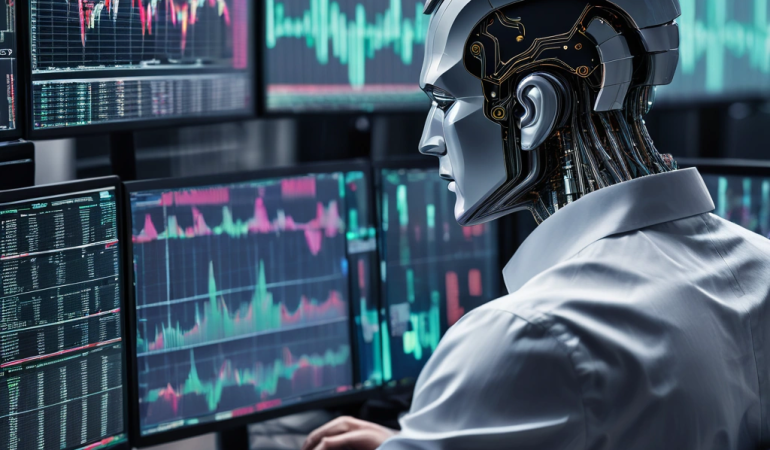
The Rise of Generative AI in High-Frequency Trading
In the relentless pursuit of market advantage, High-Frequency Trading (HFT) firms are increasingly turning to a powerful new ally: Generative Artificial Intelligence. Once confined to the realms of art and content creation, generative AI is now making waves in the high-stakes world of finance, promising to revolutionize real-time decision-making and unlock unprecedented levels of efficiency. The integration of AI into cryptocurrency markets has triggered a dramatic shift in trading dynamics, with advanced algorithms driving unprecedented market activity.
This article delves into the application of generative AI in HFT, exploring its potential benefits, inherent challenges, and the future landscape of AI-driven finance. The appeal of generative AI in finance, particularly within algorithmic trading, stems from its capacity to autonomously learn and adapt to intricate market dynamics, surpassing the capabilities of traditional rule-based systems. This marks a significant leap in AI in Finance, where algorithms can now not only analyze existing data but also generate novel scenarios and strategies.
Generative AI’s transformative potential lies in its ability to create synthetic data, simulate market conditions, and optimize trading strategies in ways previously unimaginable. Within the realm of AI Trading, this means algorithms can be trained on vast datasets, including historical market data, news feeds, and even social media sentiment, to identify patterns and predict market movements with greater accuracy. For example, GANs (Generative Adversarial Networks) can be employed to generate realistic market simulations, allowing HFT firms to backtest their strategies under diverse conditions without risking real capital.
This capability is particularly valuable in volatile markets, such as those seen in the Fintech sector, where rapid technological advancements and regulatory changes can create unpredictable trading environments. The implications of generative AI extend beyond mere automation; they represent a fundamental shift in how financial institutions approach risk management, portfolio optimization, and regulatory compliance. By leveraging generative AI, HFT firms can develop more robust and adaptive trading systems that are better equipped to handle unexpected market events and exploit fleeting opportunities. Moreover, the technology facilitates the creation of personalized investment products and services, catering to the specific needs and risk profiles of individual investors. As generative AI continues to evolve, its role in shaping the future of AI in Finance and algorithmic trading will undoubtedly become even more pronounced, driving innovation and efficiency across the entire financial ecosystem.
How Generative AI Algorithms are Adapted for HFT
Generative AI algorithms, including Generative Adversarial Networks (GANs) and transformers, are being adapted for HFT environments to enhance various aspects of the trading process. GANs, for instance, can be trained to generate synthetic market data that mimics real-world conditions, allowing traders to test and refine their strategies in a controlled environment. This is particularly useful for simulating rare events or market crashes, which are difficult to capture with historical data alone. Transformers, on the other hand, excel at processing sequential data and identifying complex patterns.
In HFT, they can be used to analyze vast streams of market data in real-time, detecting subtle anomalies and predicting short-term price movements with remarkable accuracy. These models are trained on massive datasets of historical market data, order book information, news feeds, and even social media sentiment, enabling them to learn intricate relationships and dependencies that would be impossible for humans to discern. The key adaptation for HFT lies in the optimization of these algorithms for speed and efficiency.
HFT environments demand ultra-low latency, meaning that AI models must be able to process data and generate predictions in milliseconds. This requires specialized hardware, optimized code, and innovative techniques for model compression and acceleration. One crucial adaptation lies in the architecture of these Generative AI models. Traditional GANs, while powerful, can be computationally expensive. Researchers are exploring techniques like conditional GANs (cGANs) and Wasserstein GANs (WGANs) to improve stability and training speed, making them more suitable for the demanding environment of Algorithmic Trading. cGANs, for instance, allow traders to specify conditions – such as specific market regimes or volatility levels – under which the synthetic data should be generated, leading to more targeted and relevant simulations.
Furthermore, the integration of attention mechanisms within transformer networks enables the AI to focus on the most relevant data points within the vast stream of information, improving prediction accuracy and reducing noise. This is particularly useful in identifying fleeting arbitrage opportunities or detecting subtle shifts in market sentiment that precede larger price movements. Beyond architectural improvements, the success of Generative AI in High-Frequency Trading hinges on the quality and diversity of the training data. HFT firms are investing heavily in collecting and curating massive datasets that encompass not only historical market data but also alternative data sources such as news articles, social media feeds, and even satellite imagery, according to a recent report by Celent.
These diverse datasets provide the AI with a more holistic view of the market, allowing it to identify non-linear relationships and predict market movements with greater accuracy. However, the use of such data also raises ethical considerations, particularly regarding data privacy and potential biases. Careful attention must be paid to data governance and model interpretability to ensure that AI Trading decisions are fair and transparent. Moreover, the deployment of Generative AI in HFT necessitates a shift in infrastructure.
Traditional CPUs are often insufficient to handle the computational demands of these models. HFT firms are increasingly adopting specialized hardware such as GPUs and FPGAs to accelerate the training and inference processes. These hardware accelerators can significantly reduce latency and improve the efficiency of AI Trading algorithms. For example, NVIDIA’s GPUs are widely used for training deep learning models, while FPGAs offer the flexibility to customize hardware for specific AI tasks. The integration of these technologies requires specialized expertise and significant investment, but the potential returns in terms of improved trading performance and increased profitability can be substantial, solidifying the role of AI in Finance.
Benefits: Pattern Recognition, Anomaly Detection, and Strategy Optimization
The benefits of generative AI in HFT are manifold, offering a paradigm shift in how firms approach algorithmic trading. Improved pattern recognition is perhaps the most significant advantage. Generative AI models, unlike traditional statistical methods, can identify subtle, non-linear patterns and correlations in market data that would be invisible to human traders or traditional algorithms. This capability stems from their ability to learn complex representations of market dynamics, enabling them to anticipate market movements and execute trades with greater precision.
For example, a generative AI model might detect a hidden correlation between seemingly unrelated assets, allowing an HFT firm to capitalize on arbitrage opportunities before they become widely apparent. Faster anomaly detection is another key benefit, crucial for maintaining stability and profitability in volatile markets. Generative AI can learn the normal behavior of market data – encompassing price fluctuations, trading volumes, and order book dynamics – and quickly identify deviations from this norm, flagging potential risks or opportunities for traders to investigate.
This is particularly useful for detecting and preventing fraudulent activities, such as spoofing or market manipulation, where subtle anomalies can signal malicious intent. In AI in Finance, this translates to enhanced risk management and regulatory compliance, as generative AI can provide an early warning system for potentially destabilizing market events. Optimized trading strategy development is also a major advantage, enabling HFT firms to rapidly adapt to evolving market conditions. Generative AI can be used to simulate different trading strategies and evaluate their performance in various market conditions, creating a virtual testing ground.
This allows traders to quickly identify and refine profitable strategies, without risking real capital. Moreover, generative AI can automate the process of strategy optimization, continuously adapting trading parameters to changing market dynamics. Firms are exploring reinforcement learning techniques, powered by generative AI-created synthetic data, to fine-tune their algorithms in real-time, achieving a level of adaptability previously unattainable. This agility is paramount in the fast-paced world of HFT, where even milliseconds can determine success or failure.
Furthermore, generative AI facilitates enhanced alpha generation through sophisticated feature engineering. By analyzing vast datasets, these models can automatically discover novel features predictive of future price movements. This is a significant departure from traditional methods that rely on human intuition and pre-defined indicators. Generative models can identify complex interactions between various market variables, creating unique signals that drive profitability. The ability to autonomously learn and adapt feature sets ensures that trading strategies remain competitive and resilient in the face of ever-changing market dynamics. This represents a significant step forward in AI Trading, allowing firms to leverage the power of data to uncover hidden sources of alpha.
Challenges and Risks: Data Quality, Interpretability, and Regulatory Compliance
Despite its transformative potential, the integration of generative AI in HFT introduces significant challenges and risks that demand careful consideration. Data quality remains paramount; generative AI models are fundamentally limited by the data upon which they are trained. Incomplete, inaccurate, or biased datasets inevitably lead to unreliable predictions and potentially flawed trading strategies. For instance, if historical market data used to train a GAN contains anomalies due to past market manipulations, the generative AI may inadvertently replicate these patterns, leading to erroneous trading signals.
The Securities and Exchange Commission (SEC) has emphasized the importance of data governance in algorithmic trading, a principle that extends directly to generative AI applications. Therefore, rigorous data cleaning, validation, and bias mitigation techniques are essential for ensuring the reliability of generative AI-driven HFT systems. Model interpretability poses another hurdle. Generative AI models, particularly deep learning architectures like transformers, often operate as ‘black boxes,’ making it difficult to understand the reasoning behind their predictions. This lack of transparency creates challenges for risk management and regulatory compliance.
If a generative AI model generates a trading signal that results in a significant loss, it can be difficult to determine the root cause of the error and prevent similar occurrences in the future. Furthermore, regulators are increasingly scrutinizing the explainability of AI-driven financial systems. The inability to explain how a generative AI model arrived at a particular trading decision could lead to regulatory scrutiny and potential penalties, particularly under regulations like the EU’s AI Act, which emphasizes transparency and accountability in AI systems.
Regulatory compliance adds another layer of complexity. HFT firms operate within a highly regulated environment, and any AI system deployed must adhere to these regulations. However, existing regulations often predate the widespread use of AI and may not explicitly address the unique challenges posed by generative AI. For example, regulations regarding market manipulation may be difficult to apply to generative AI models that generate synthetic market data for strategy testing. Firms must proactively engage with regulators to ensure that their generative AI systems comply with all applicable rules and guidelines.
This includes establishing robust monitoring and oversight mechanisms to detect and prevent potential violations. A recent white paper by the Financial Industry Regulatory Authority (FINRA) highlighted the need for firms to develop comprehensive AI governance frameworks that address regulatory compliance, ethical considerations, and risk management. The potential for algorithmic bias represents a significant risk. Generative AI models can inadvertently learn and perpetuate biases present in the training data, leading to unfair or discriminatory outcomes. In the context of HFT, this could manifest as biased trading signals that systematically disadvantage certain market participants or amplify existing market inequalities.
For example, if the training data contains historical price data that reflects discriminatory trading practices, the generative AI model may learn to replicate these practices, leading to biased trading outcomes. Addressing algorithmic bias requires careful attention to data diversity, fairness metrics, and ongoing monitoring of model performance. Firms should implement robust bias detection and mitigation techniques to ensure that their generative AI systems operate fairly and equitably. Furthermore, the rise of AI trading platforms, as noted by Disrupt Africa, necessitates heightened vigilance against potential scams and the need for thorough vetting processes to safeguard investments and maintain market integrity.
Future Trends and Potential Advancements
While specific, fully-detailed case studies of generative AI implementation in HFT are often closely guarded secrets, some general examples illustrate its application. Some firms are using GANs to create synthetic market data for backtesting new trading strategies, allowing them to evaluate performance without risking real capital. Others are employing transformers to analyze news feeds and social media sentiment, identifying potential market-moving events before they occur. Still others are using generative AI to optimize their order execution algorithms, minimizing slippage and maximizing profits.
Looking ahead, the future of generative AI in HFT is bright. As AI technology continues to advance, we can expect to see even more sophisticated applications emerge. One potential trend is the development of AI models that can learn and adapt in real-time, continuously improving their performance as market conditions change. Another is the integration of generative AI with other advanced technologies, such as quantum computing, to create even more powerful trading systems. The integration of AI into cryptocurrency markets has triggered a dramatic shift in trading dynamics, with advanced algorithms driving unprecedented market activity.
However, it’s crucial to approach this technology with caution, ensuring ethical considerations and regulatory compliance are at the forefront of its development and deployment. Further advancements in Generative AI for Algorithmic Trading are expected to focus on creating more robust and adaptable models. The current generation of AI Trading systems often struggles with unforeseen market events or regime changes. Future models will likely incorporate reinforcement learning techniques, allowing them to continuously learn from their mistakes and adapt to changing market dynamics in real-time.
This could involve training AI agents to simulate different market scenarios and learn optimal trading strategies through trial and error, leading to more resilient and profitable HFT systems. The ability to generate diverse and realistic synthetic data will be crucial for training these advanced models, mitigating the risks associated with overfitting to historical data. Moreover, the confluence of AI in Finance and Fintech innovation is driving the development of more sophisticated risk management tools. Generative AI can be leveraged to simulate extreme market events and assess the potential impact on trading portfolios.
By generating a wide range of plausible scenarios, including black swan events, these models can help HFT firms identify vulnerabilities and develop strategies to mitigate potential losses. This proactive approach to risk management is particularly important in the high-stakes world of HFT, where even small errors can have significant financial consequences. Regulatory bodies are also increasingly scrutinizing the use of AI in financial markets, emphasizing the need for transparency and accountability. Ultimately, the successful integration of Generative AI into High-Frequency Trading hinges on addressing key challenges related to data governance, model interpretability, and ethical considerations.
High-quality, unbiased data is essential for training reliable AI models. Furthermore, understanding how these models arrive at their decisions is crucial for building trust and ensuring compliance with regulatory requirements. As Generative AI becomes more deeply embedded in the fabric of Algorithmic Trading, ongoing research and collaboration between AI experts, financial professionals, and regulators will be essential to harness its full potential while mitigating its inherent risks. This collaborative approach will pave the way for a future where AI-driven financial markets are more efficient, resilient, and equitable.